How to Choose an Empty Eyeshadow Palette for Your Brand
Choosing an Empty Eyeshadow Palette for your brand starts with how customers will use it. A compact palette may suit travel, while a larger case gives artists room to work. Consider the number and size of pans, the lid’s viewing window, and whether the closure feels secure in a bag. Small details matter. A loose hinge can make a polished product feel unreliable. The case should also fit your brand’s visual style without making everyday use awkward. Ask suppliers about available materials, finishes, minimum order quantities, and decoration options. Then request samples. Product photos rarely show how a surface feels under real lighting.
Test the palette with the powders you plan to sell. Check pan fit, fallout around the edges, and how easily customers can open and close the case. If you offer refillable pans, confirm that replacements fit consistently; never assume every supplier uses the same dimensions. Packaging should protect the product during ordinary handling, but avoid promising performance you have not tested. Compare sample quality, communication, and production consistency, not just the quoted price. A low-cost option may bring hidden trade-offs. And sometimes, the first sample is not the right one. That is useful information, even if it slows the launch. Keep notes, photograph your checks, and get clear specifications before approving production. The best choice is the one that works for your product, budget, and customers—not simply the one that looks impressive on a screen.
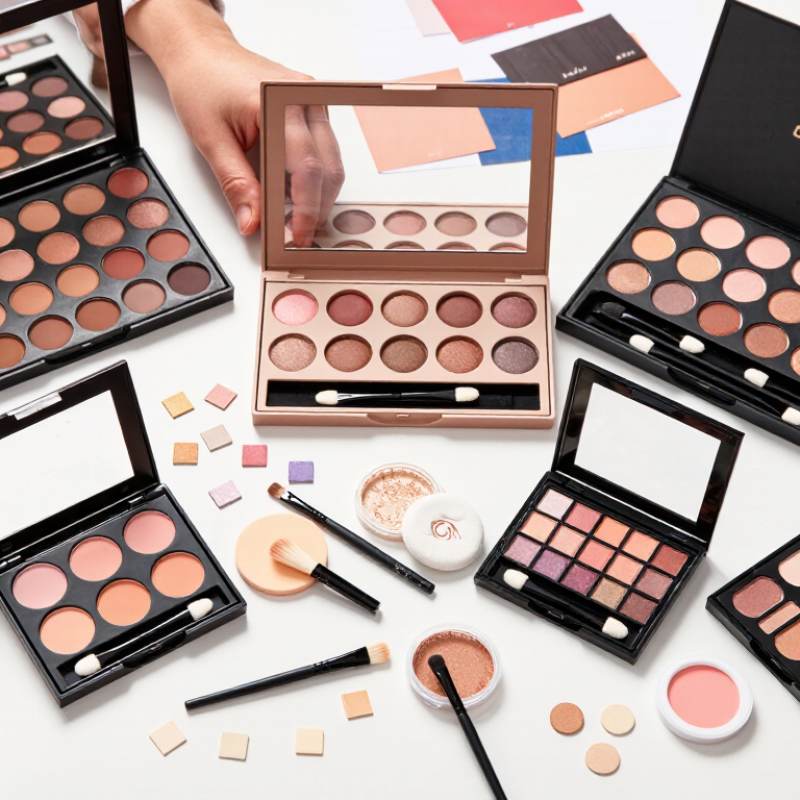
Define Your Brand’s Product and Packaging Requirements
Before choosing an empty eyeshadow palette, define what it must hold and how customers will use it. Record each pan’s diameter and depth, the number of shades, and whether inserts need to be removable. A sample tray can reveal a problem drawings miss: pans may sit too close to the edge for a fingertip or brush. Check the lid’s opening angle, mirror size, closure strength, and available space for product information. Small details matter.
Packaging choices should fit the palette’s weight, finish, and shipping route. A glossy surface may show fingerprints; a soft-touch finish can scuff during transit. Ask suppliers for material specifications, prototype samples, and drop-test results.
The U.S. EPA’s 2018 Advancing Sustainable Materials Management report counted 82.2 million tons of U.S. municipal solid waste from containers and packaging. Eurostat reported 186.5 kilograms of packaging waste per EU resident in 2022. These figures make material use worth examining early, not after the design is fixed.
Decide whether a refillable format suits the product, and test how easily users can replace a pan without damaging the case. Confirm minimum order quantities, production tolerances, and whether custom colors affect lead time. Get the details in writing.
One imperfect step is relying on a digital mock-up alone; it cannot show hinge stiffness or the feel of a latch. Compare physical samples under bright retail lighting and in a handbag.
Compare Palette Materials, Sizes, and Configurations
Material choice affects both appearance and daily use. Paperboard can feel light and offer broad printing options, while plastic or metal often provides a firmer shell. Compare hinge movement, closure strength, and resistance to powder dust before choosing. Feel matters. A glossy surface may look refined in a sample, yet show fingerprints under store lighting. That assumption needs testing.
Size should match the intended number and shape of pans. Measure each pan, then leave enough room for dividers and a comfortable brush or finger pickup. A compact palette is easier to carry, but tight spacing can make shades awkward to use. Larger formats create more layout freedom and may add shipping weight. Check the filled palette, not only its empty shell.
Configuration shapes how customers interact with the product. Removable pans support shade changes, while fixed pans can simplify assembly. A mirror adds convenience but needs secure placement and protection during transit. Choose square, rectangular, or mixed pan layouts around the shade story, rather than forcing the story into a standard grid. Test a working sample with real pans and repeated opening. Test it. Note any loose pans, sharp edges, or lids that do not stay open; small defects can become costly after production scales.
Assess Customization Options and Pan Compatibility
Customization should make an empty palette useful, not merely attractive. Decide how many pans it needs, where they sit, and whether users may rearrange them. A removable magnetic base offers flexibility, but only when the pans and base are compatible. Fixed pans can feel sturdier, though they limit future layouts. Small details matter.
Check pan diameter and depth against the palette’s cavity, using actual samples rather than relying on product photos. A difference of a millimeter can leave a pan loose or make it difficult to remove. Confirm whether the base uses magnets, adhesive, or a fitted insert, and ask for written dimensions and material details.
Then test a sample with the formulas and tools your customers are likely to use. A deep pan may suit a bulky product, but it can make the palette harder to close.
Test before scaling.
It is easy to assume one standard size will work; that assumption can be wrong. A small pilot order may reveal awkward gaps, weak magnetic hold, or a layout that wastes space. Keep room for adjustment when approving the final specification.
Verify Supplier Quality, Safety, and Production Standards
How to Choose an Empty Eyeshadow Palette for Your Brand
A dependable supplier should explain how each palette is made, not just offer attractive photos. Ask about material specifications, production controls, and how components are traced from purchase to assembly. For plastic or metal pans, request details on material consistency and surface coatings. Small flaws matter. Rough edges can scratch fingers, while a loose hinge may fail after repeated opening.
Check safety documents relevant to your intended markets, including material and coating information. Do not assume. Ask who prepared each document and whether it covers the exact palette components you plan to order. Inspect a physical sample for sharp seams, odor, residue, and lids that close evenly. A polished sample may still hide weak hinges or uneven finishes in a larger run, so request production samples when possible. It is easy to focus on appearance and miss the boring details.
Tips: Ask for the supplier’s inspection checklist and defect limits. Confirm how often checks occur, how rejected parts are handled, and whether changes to materials require your approval. Keep the answers in writing. Then compare the sample with the first production batch, including hinge tension and pan fit. A small mismatch is worth investigating before it becomes a full shipment issue.
Evaluate Costs, Minimum Orders, and Delivery Timelines
An empty eyeshadow palette can seem inexpensive until tooling, inserts, and freight appear on the quote. Compare landed cost, not unit price. Ask suppliers to separate mold or tooling charges, sample fees, unit prices, packaging, and shipping. Then compare prices at several order quantities. A low minimum order can protect cash flow, while a larger minimum may lower each unit’s cost and leave you with stock you cannot use. Small details matter. Request the cost of a color change or revised pan layout before approving a sample. McKinsey’s 2020 survey of supply-chain leaders found that 93% planned to make supply chains more flexible, agile, and resilient. That broad finding is a useful reminder: avoid relying on one quote or one supplier’s estimate.
For delivery, ask for separate dates for sampling, production, quality checks, and transit. “Four weeks” is not a schedule. Get it in writing. Confirm when the clock starts, whether weekends count, and what happens if a sample needs changes. Add a buffer for freight delays, especially when your launch date is fixed. I would not treat a quoted lead time as a promise; it is an estimate unless the stages and assumptions are clear. Compare the supplier’s timeline with your own approval process, since slow feedback can add days too. A neat spreadsheet helps, but it cannot fix an unclear quote.
How to Choose an Empty Eyeshadow Palette for Your Brand - Evaluate Costs, Minimum Orders, and Delivery Timelines
| Palette Option | Typical Construction | Indicative Unit Cost (USD) | Typical Minimum Order | Estimated Production Time | Best Fit |
| Stock 4-pan compact | Ready-made plastic case with four wells; basic decoration options | $0.60–$1.50 | 500–1,000 units | 2–4 weeks | Small launches, sampling, or testing a new product concept |
| Stock 9-pan palette | Ready-made plastic case with nine wells; label or simple print customization | $1.00–$2.50 | 500–1,000 units | 3–5 weeks | Mid-sized collections that need more shade capacity without custom tooling |
| Stock 12-pan palette with mirror | Ready-made case with twelve wells, mirror, and standard closure | $1.50–$3.50 | 1,000–2,000 units | 3–6 weeks | Retail-ready assortments where portability and an integrated mirror matter |
| Custom-decorated stock palette | Existing case shape with custom color, logo, printing, or surface finish | $1.80–$4.50 | 1,000–3,000 units | 4–7 weeks | Brands seeking a more distinctive look while using an existing case design |
| Custom-molded palette | New case shape or configuration requiring a dedicated mold | $2.50–$7.00, plus tooling | 3,000–10,000 units | 10–18 weeks, including tooling | Large launches that justify a unique shape, layout, or closure |
| Magnetic refillable palette | Reusable case with magnetic wells or removable pan inserts | $2.00–$6.00 | 1,000–3,000 units | 5–9 weeks | Refill programs, customizable shade assortments, or reusable packaging plans |
Planning note: Cost and lead-time figures are indicative estimates for empty palettes, not supplier quotations. Actual pricing depends on order quantity, materials, dimensions, decoration, inserts, testing, and packaging. Production time generally starts after artwork and specifications are approved; custom tooling, samples, freight, duties, and taxes may add time or cost. Confirm the final minimum order and delivery schedule with suppliers before placing an order.