Food packaging decisions begin with the product, not the roll of foil. A chilled sandwich, a baked pastry, and a powdered drink mix place different demands on their packaging. Choosing foil paper for food therefore means balancing barrier performance, strength, sealing, and processing needs. Small details matter. A sharp edge or tight fold can expose weak points.
The scale of food loss makes careful packaging decisions relevant, though packaging cannot solve the problem alone. FAO’s 2023 SDG progress reporting estimated that 13.2% of food was lost after harvest and before retail in 2021. That figure is not a measure of packaging’s effect. It does show why protection during storage and distribution deserves attention. Foil can block light and provide a strong barrier to moisture and gases, but the finished pack’s performance also depends on thickness, pinholes, coatings, and laminate design. A technically impressive material can still be the wrong choice.
This guide explains how to compare foil grades, thicknesses, and food-contact structures for different uses. It also considers heat exposure, forming, sealing, and the realities of converting equipment. Ask suppliers for product specifications and test results, then check them against the actual food and packing conditions. There is no universal best foil. Even a sound recommendation may need revision after line trials; that is an inconvenient, but useful, truth.
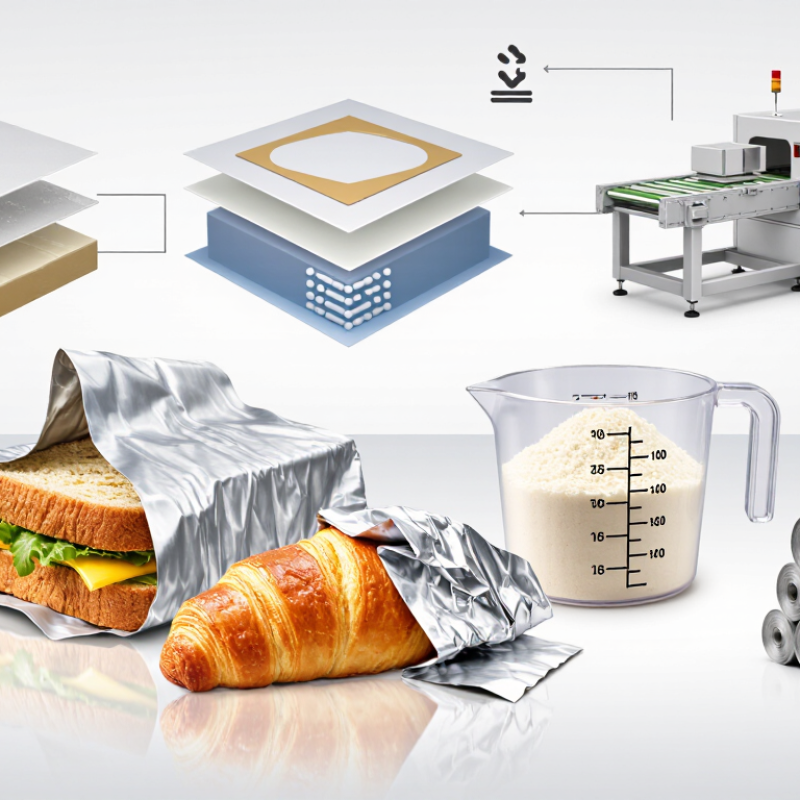
Foil paper is typically paper bonded to a thin aluminum-foil layer. The paper gives the pack stiffness and a printable surface; the foil can limit light, moisture, and oxygen exposure. It is not the same as metallized paper, which has a much thinner metal coating. That distinction matters when comparing barrier performance. The Flexible Packaging Association’s 2023 State of the Industry report estimated U.S. flexible-packaging sales at $42.9 billion in 2022, with food accounting for about half of the market. The figure covers flexible packaging broadly, not foil paper alone.
Typical uses include butter wraps, chocolate liners, tea sachets, and dry-food pouches. A wrapper around a chilled butter block needs clean folds and reliable grease resistance. A pouch for crisp snacks may need stronger moisture protection and heat-sealable edges. Check the intended food-contact surface, seal temperature, and barrier specifications against the actual product and filling process. Small differences in laminate construction can change how well a pack holds its shape or protects aroma.
Ask suppliers for test results, not just a “high-barrier” description. Look for oxygen- and water-vapor-transmission data, measured under stated conditions. Also confirm whether the paper and foil combination suits your disposal stream; bonded layers can be difficult to separate. One easy mistake is choosing the thickest foil by default. More material may add cost without solving the real problem, and that assumption deserves a packaging trial.
Typical aluminum foil thickness ranges by food-packaging use (micrometers, µm)
Foil thickness is one factor in choosing packaging: thinner foil is commonly used in flexible laminates, while thicker foil is used for more rigid containers. These ranges are indicative; the right choice also depends on the food, required barrier protection, forming needs, and the complete packaging structure.
Start with the food, not the roll. Note whether it is oily, wet, acidic, salty, hot, or dry, and how long it will stay wrapped. Fresh pastries may need grease resistance and enough stiffness to hold their shape. A chilled sandwich has different needs. That matters. Moisture can soften paper, while oil may stain it or seep through a weak layer.
Next, define the package’s job. Will it wrap food by hand, line a tray, or run through a filling machine? Consider whether it must fold tightly, resist tearing, or seal at the edges. Foil can help limit light, air, and moisture transfer, but performance depends on the full construction. Paper weight, foil thickness, coatings, adhesives, and tiny defects all play a part. A shiny surface alone proves little.
Check the intended temperature and handling conditions, too. A wrapper used for chilled food may not suit oven heating, and foil-containing packaging should not be assumed microwave-safe. Ask suppliers for food-contact documentation that matches the food type and use conditions. Then test a real sample with the actual product: leave it wrapped, inspect for leaks, odor, softening, and difficult opening. I have seen teams choose a heavier material before checking the seal; it solved the wrong problem. A small trial can expose that mistake early.
Food foil is not one material. Plain aluminum foil offers a strong barrier against light, oxygen, and moisture when it remains intact. It works well for wrapping dry or greasy foods, but thin foil can tear around sharp edges. Laminated foil combines aluminum with paper or plastic film. Paper can add stiffness, while a polymer layer may support heat sealing. The trade-off is a package with more layers to separate or assess. That detail is easy to overlook.
Thickness affects handling and barrier reliability, but thicker is not automatically better. A thin sheet may suit a short-use wrapper; a heavier gauge can resist punctures during filling and transport. Creases and repeated flexing still matter. Tiny cracks can reduce protection. Coatings also change performance: lacquer may protect the metal or product, while a sealable coating can help close a pouch. Check that the coating is specified for the food, temperature, and contact time involved. Then test the actual filled package, not just a flat sample. Results can be untidy, and one trial may not represent every production run.
| Foil Type | Typical Aluminum Thickness | Common Structure or Coating | Useful Packaging Properties | Common Food Uses | Selection Considerations |
|---|---|---|---|---|---|
| Lightweight flexible foil | About 6–12 µm | Often laminated to paper or plastic film; may include a heat-seal layer | Strong light, moisture, and gas barrier when the foil layer is continuous; flexible and lightweight | Chocolate, confectionery, butter portions, sachets, and dry-food packs | Thin foil can crease or tear more easily. Lamination and seals help protect the package and may be needed for reliable conversion. |
| Standard household-style foil | About 12–18 µm | Usually uncoated aluminum foil; packaging versions may use a printed or coated surface | Good barrier to light, moisture, odors, and gases; easy to fold around products | Wrapping cheese, baked goods, sandwiches, and chilled foods | Suitable for many wraps, but check compatibility with acidic or salty foods and avoid direct contact where the product specification advises against it. |
| Heavy-duty foil | About 18–25 µm | Usually uncoated aluminum; may be paired with paper or a polymer layer | Greater resistance to puncture and handling damage than thinner foil; good barrier when intact | Food-service wraps, larger portions, and products needing a tougher wrap | Choose when durability matters. It is heavier and may cost more per package than lightweight foil. |
| Foil-paper laminate | Commonly about 6–12 µm of foil, bonded to paper | Aluminum foil laminated to paper with an adhesive or bonding layer; an inner seal layer may also be used | Combines foil barrier properties with the stiffness and printable surface of paper | Butter and margarine wraps, bakery products, confectionery, and some dry foods | Check the food-contact layer, adhesive suitability, fold performance, and whether the laminate is designed for the intended storage conditions. |
| Lacquered or coated foil | Often about 8–20 µm, depending on the application | One or both sides receive a thin lacquer or protective coating | Coating can improve surface protection, printability, or resistance to product interaction; foil provides the main barrier | Cheese, confectionery, and selected products requiring a protected or printable foil surface | Coating performance depends on its formulation and intended use. Confirm food-contact compliance and compatibility with the food. |
| Heat-sealable foil laminate | Often about 6–12 µm of foil within a multilayer structure | Foil bonded to polymer film or paper with a heat-seal layer on the package-contact side | Provides a foil barrier and can form sealed packs when used with compatible sealing equipment | Portion packs, lidding, sachets, and packaged snacks or ingredients | Seal quality depends on the sealant, temperature, pressure, dwell time, and package design. Specify the required sealing conditions. |
| Rigid aluminum foil container stock | Commonly about 30–100 µm, depending on container size and design | Formed aluminum sheet; may have a food-contact lacquer or coating for particular products | Rigid, shape-retaining, and suitable for oven use when the container and application are designed for it | Meal trays, pie plates, baking containers, and take-away food trays | Check the container specification for oven, freezer, sealing, and food-contact suitability. Do not assume every coated container is suitable for every use. |
Thickness ranges are indicative and vary by supplier, product design, and market. For commercial packaging, confirm the material specification, food-contact compliance, seal performance, and storage conditions with the packaging supplier.
Choose foil by the food and process, not by shine alone. Ask suppliers for food-contact documentation and migration-test results matching the intended food, temperature, and contact time. Acidic sauces and salty fillings deserve closer migration review, especially during heating. Plain foil is not automatically suitable for every recipe. Check thickness and pinholes, then test sealing and puncture resistance on a production line. A small bench sample can miss wrinkles that appear at filling speed.
For sustainability, the International Aluminium Institute reports that recycling aluminium uses about 95% less energy than producing primary aluminium. That industry figure describes aluminium broadly, not the footprint of every foil pack. Recovery depends on local collection and sorting; thin, food-soiled foil may not enter the recycling stream. Check local acceptance rules and whether the package separates cleanly from paper or plastic. Life-cycle results also shift with recycled content, electricity mix, and transport. The awkward caveat: recyclable does not mean recycled. Choose the lightest gauge that survives filling, folding, and heating, then track scrap rates during real production runs.
Choosing foil paper starts with the food, not the roll. A dry pastry needs different protection from a warm, oily sandwich. Note the product’s moisture, fat, temperature, and expected storage time. Then compare foil thickness, paper weight, coating, and foldability. Thicker foil is not automatically better. It may crease or tear at tight corners.
Ask for food-contact documentation for the intended use and market. Check whether the material suits direct contact, hot filling, freezing, or reheating. The package should also work with your filling and sealing equipment. A neat sample may fail on a fast production line. Test actual production conditions.
Pack real portions, not empty mock-ups. Inspect seals, edges, and folds after handling and storage. Look for grease spots, damp patches, pinholes, unusual odor, or foil cracks near sharp corners. Compare samples after chilled and room-temperature storage when both conditions matter. Record small failures. They matter. Repeat tests with more than one batch; one clean-looking sample can mislead. Appearance alone is not enough.