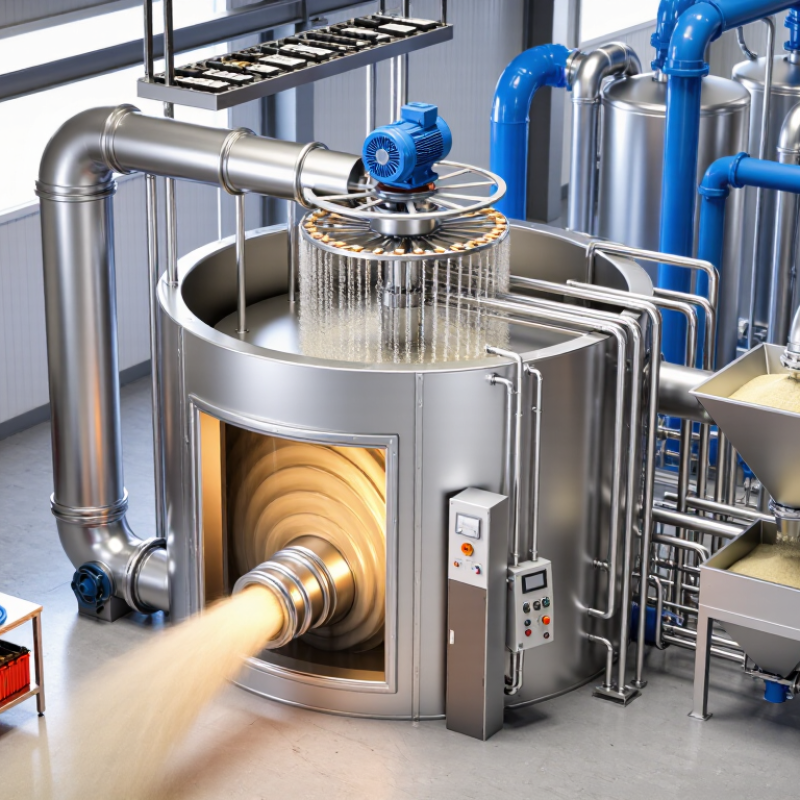
Choosing Spray Drying Equipment in 2026 requires more than comparing advertised capacity or purchase price. Manufacturers now face tighter energy targets, changing ingredient profiles, stricter hygiene expectations, and pressure to reduce production waste. A reliable selection process begins with the powder itself. Moisture content, stickiness, heat sensitivity, particle size, bulk density, and target solubility all influence equipment design.
Small details matter.
A food-grade dairy powder may require gentle drying and precise temperature control. A ceramic slurry may need different atomization, chamber materials, and collection methods. In practical projects, pilot testing often reveals problems that brochures do not show, including wall buildup, uneven particles, or difficult cleaning access. These findings can prevent expensive modifications after installation.
This guide examines how to evaluate Spray Drying Equipment for real production conditions in 2026. It considers atomizer type, drying chamber geometry, air filtration, cyclones, bag filters, automation, heat recovery, and clean-in-place systems. Total ownership cost also deserves attention. Electricity, compressed air, maintenance, spare parts, downtime, and operator training can outweigh the initial quotation.
There is no universal best machine.
The most suitable system balances product quality, throughput, safety, service support, and future expansion. However, selection decisions are not always perfect. Laboratory data may be limited, and supplier performance claims require verification. Strong buyers request references, review test results, inspect critical components, and define measurable acceptance criteria before signing a contract. Careful engineering judgment remains essential, especially when efficiency goals conflict with gentle product handling.
Define the product before comparing equipment. Record feed viscosity, solids content, heat sensitivity, target moisture, water activity, particle size, density, and solubility. These details determine atomization, inlet temperature, residence time, and powder separation.
A practical lesson from pilot trials is simple: a stable liquid can behave unpredictably after concentration. Small changes matter. Test it.
Food products require strict control of microbial risk, oxidation, and thermal damage. The FAO’s State of Food and Agriculture 2019 estimated that 14% of food is lost between harvest and retail.
Better drying cannot solve every loss, but it can improve stability and reduce reprocessing. Define the acceptable moisture range, not one attractive laboratory number.
Include cleaning time, allergen changeover, and powder recovery in the requirement sheet.
Energy deserves equal attention. The U.S. Department of Energy’s Industrial Decarbonization Roadmap identifies process heating as roughly 51% of energy use in U.S. manufacturing.
Compare thermal efficiency under your actual feed conditions, rather than relying on catalogue figures. A higher outlet temperature may increase capacity, yet damage flavor or color.
The first specification is rarely perfect. Recheck it against pilot data, seasonal raw-material changes, and the operator’s real cleaning routine.
How to Choose Spray Drying Equipment in 2026?
Selecting a spray dryer should begin with the feed, not the equipment catalogue. Measure solids content, viscosity, surface tension, heat sensitivity, and stickiness under actual production conditions. A thin, water-based solution may suit a pressure nozzle, while a viscous suspension often needs rotary atomization. Small details matter. A feed that thickens during storage can change droplet size and destabilize production.
Atomization determines the starting point for particle design. Rotary systems can tolerate broader feed variation, but they may produce wider particle distributions. Nozzle systems offer focused control, although blockage becomes a practical concern. For heat-sensitive materials, use shorter residence times, gentle inlet profiles, and rapid powder cooling. Hygroscopic feeds may require dehumidified air and a chamber designed to limit wall deposits. Test powder behavior at the intended moisture level, not only in laboratory form.
Pilot trials should record feed temperature, outlet temperature, airflow, droplet appearance, yield, and wall buildup. These observations reveal problems that calculations can miss. Experienced engineers also inspect powder recovery and cleaning access before approving a layout. No design is perfect. A system optimized for yield may compromise particle porosity or reconstitution speed. Leave room for adjustment. Recheck assumptions when the feed changes supplier, concentration, or seasonal moisture. Document those changes before adjusting atomization settings.
Atomization controls particle size, moisture, and wall deposition. Rotary atomizers suit high-throughput feeds and tolerate moderate viscosity. Pressure nozzles produce narrower distributions when feed pressure remains stable. Two-fluid nozzles offer flexible laboratory control, but compressed-air demand can increase operating costs. MarketsandMarkets’ 2024 industry outlook projects the spray drying equipment market to grow at roughly 7% annually through 2029, driven partly by food and pharmaceutical powder production.
Chamber design matters just as much. A co-current chamber protects heat-sensitive materials because wet droplets meet the hottest air first. Mixed-flow designs can improve thermal efficiency, but residence-time control becomes more demanding. Tall-form chambers support longer drying paths and lower final moisture. Cylindrical-conical chambers are often easier to clean and inspect. In practice, I check the powder outlet with a flashlight. Sticky deposits reveal problems faster than a spreadsheet.
Pilot trials should compare yield, bulk density, outlet temperature, and cleaning time. Grand View Research’s 2024 analysis identifies food and pharmaceutical processing as major application areas, where repeatability remains critical. A perfect droplet-size target can be misleading. Feed solids may change during storage, and laboratory results may not scale smoothly. I would request tests using the real formulation, not water or a convenient substitute. Chamber insulation, air filtration, and exhaust handling also deserve measured review. The cheapest quote can become expensive when energy use and downtime accumulate.
Choosing spray drying equipment in 2026 requires more than comparing chamber size. Capacity should match peak demand, not average production. Calculate feed solids, moisture removal, residence time, and cleaning delays. A unit rated for 500 kilograms per hour may deliver less during humid weather or frequent product changes. The European Commission’s 2019 BAT Reference Document for Food, Drink and Milk Industries emphasizes that drying performance depends strongly on feed concentration and heat recovery. That detail is easy to overlook.
Energy use deserves a measured test. The International Energy Agency’s Energy Efficiency 2023 report identifies industrial heat as a major efficiency opportunity. Ask suppliers for specific energy consumption, measured as megajoules per kilogram of evaporated water. Compare inlet and outlet air temperatures, exhaust humidity, and actual powder yield. I would also request a witnessed factory trial. Laboratory figures can look excellent, yet unstable feed flow may increase energy use and create wall deposits. This is where specifications sometimes become optimistic.
Tips: Require trend records for airflow, temperature, pressure, and motor load. Select automation that gives operators clear alarms, not endless screens. Remote monitoring can reduce reaction time, but it cannot replace trained staff. Maintenance planning should include nozzle inspection, filter replacement, gasket checks, and access to the chamber interior. The European Commission’s BREF guidance supports preventive control and resource efficiency, but maintenance intervals still depend on powder behavior. A cheap spare-parts plan may become expensive after one unexpected shutdown. Check it honestly.
Comparative planning index for capacity, energy efficiency, automation, and maintenance. A higher score indicates a more favorable selection profile; actual performance depends on feed properties, product requirements, and operating conditions.
Typical reference ranges used for the index: evaporation capacity of approximately 50–2,000 kg of water per hour, thermal energy demand of about 3.5–5.0 MJ per kg of evaporated water, automation maturity from basic control to recipe-based closed-loop control, and planned maintenance of roughly 8–30 hours per month. Use site-specific quotations and trials before final equipment selection.
How to Choose Spray Drying Equipment in 2026?
Safety and compliance should shape the specification, not decorate it afterward. OSHA recorded 281 combustible-dust incidents, 119 deaths, and 718 injuries from 1980 to 2005. The figures remain a serious warning. Ask for explosion relief, isolation, grounding, temperature interlocks, and documented hazard assessments. Check applicable requirements, including ISO 12100, pressure equipment rules, sanitation standards, and combustible-dust codes. Local enforcement differs. Assumptions can become expensive.
Energy performance deserves equal attention. The U.S. Department of Energy reports that process heating uses about 51% of manufacturing energy. Compare thermal efficiency, exhaust losses, heat recovery, cleaning time, and compressed-air demand. Request validated performance data using your actual feedstock, moisture target, and production rate. A laboratory trial may look perfect. Full-scale powder behavior can still surprise you.
Supplier support affects total cost more than many quotations reveal. Require commissioning plans, operator training, spare-parts availability, remote diagnostics, and defined response times. Review the control system carefully. Can your technicians access meaningful alarms, trends, and recipes? Calculate five-year cost, including utilities, filters, seals, labor, downtime, and disposal. The lowest purchase price is often not the lowest operating cost. Still, every model has blind spots. Challenge the supplier’s assumptions, and record what remains unverified.
| Decision Area | Evaluation Dimension | Laboratory / R&D Dryer | Pilot-Scale Dryer | Production Dryer | Closed-Loop / Inert-Gas Dryer |
|---|---|---|---|---|---|
| Safety | Typical application | Formulation screening, small-batch testing, and powder-property development. | Process scale-up, residence-time studies, and validation of atomization settings. | Continuous commercial manufacturing with automated process control. | Processing flammable, oxygen-sensitive, or solvent-based feeds in an inert atmosphere. |
| Explosion-risk controls | Basic to medium Use suitable ventilation, dust control, grounding, and documented operating procedures. | Medium to high May require explosion relief, isolation, suppression, and dust-hazard assessment. | High Requires a documented combustible-dust assessment and engineered protection appropriate to the site and powder. | High Oxygen monitoring, inert-gas control, pressure protection, and validated interlocks are normally required. | |
| Typical operating temperature range | Inlet air commonly about 100–250 °C; outlet temperature is product-dependent. | Inlet air commonly about 120–250 °C; outlet temperature often about 50–110 °C. | Inlet air commonly about 150–300 °C; outlet temperature often about 60–120 °C. | Often selected for solvent or heat-sensitive feeds; actual temperatures depend on solvent, product, and validated process limits. | |
| Safety documentation to request | Risk assessment, electrical documentation, operating instructions, and cleaning procedure. | Functional safety description, equipment drawings, pressure-relief basis, and commissioning records. | Full safety file, hazard analysis, interlock matrix, relief-system design, and site-integration documentation. | Oxygen-control philosophy, inert-gas safety assessment, solvent recovery documentation, and emergency procedures. | |
| Compliance | Hygienic design | Prefer smooth product-contact surfaces, accessible cleaning points, and minimal powder-retention areas. | Should support documented cleaning, inspection, and material traceability. | Typically requires sanitary construction, validated cleaning methods, controlled utilities, and documented change control. | Requires hygienic product-contact design plus controlled handling of inert gas and recovered solvent where applicable. |
| Common regulatory references | Applicable electrical, pressure, machinery, and laboratory safety requirements. | Applicable machinery, pressure equipment, electrical, dust-explosion, and quality-system requirements. | Depending on location and product: GMP expectations, pressure-equipment rules, combustible-dust standards, and hazardous-area requirements. | Depending on location and solvent: hazardous-area rules, pressure-equipment requirements, solvent-emission controls, and inert-gas safety standards. | |
| Data integrity and traceability | Often limited Basic temperature, pressure, and batch records may be available. | Moderate Recipe control, alarm history, calibration records, and electronic batch reporting are commonly specified. | High Specify audit trails, user permissions, electronic records, calibration management, and recipe version control when required. | High Continuous oxygen, pressure, solvent, and batch data may need secure records and reviewable alarm history. | |
| Validation effort | Low to moderate; mainly method development and equipment qualification. | Moderate; often used to establish scale-up parameters and repeatability. | High; normally includes installation, operation, performance, cleaning, and process validation activities. | High; includes inerting performance, oxygen control, solvent handling, containment, and process validation. | |
| Supplier Support | Scale-up support | Useful for screening, but laboratory results alone may not predict production performance. | Strong fit Best suited to testing atomizer type, feed rate, residence time, powder recovery, and thermal behavior before production purchase. | Requires process guarantees supported by representative trials and a defined acceptance-test protocol. | Requires solvent, oxygen, pressure, and powder-safety expertise in addition to normal spray-drying experience. |
| Commissioning and training | Remote or short on-site training is often sufficient. | Plan for installation supervision, operator training, trial support, and troubleshooting during start-up. | Require documented commissioning, operator certification, maintenance training, and production handover. | Require specialist start-up support covering inert-gas operation, emergency shutdowns, solvent recovery, and permit-to-work procedures. | |
| Spare-parts and service expectations | Critical parts include seals, filters, nozzles, thermocouples, and pump components. | Request recommended spare-parts lists, response times, remote diagnostics, and preventive-maintenance schedules. | Request local or regional service coverage, guaranteed response times, critical-spares availability, and lifecycle support. | Request support for oxygen sensors, inert-gas valves, solvent seals, pressure-relief devices, and safety instrumentation. | |
| Supplier scorecard questions | Can the supplier provide repeatable test data and cleaning instructions? | Can the supplier demonstrate scale-up from representative feed material? | Are utilities, performance guarantees, acceptance criteria, and maintenance responsibilities clearly defined? | Can the supplier document safe operation with the specified solvent, oxygen limit, powder, and recovery system? | |
| Total Cost of Ownership | Main capital-cost drivers | Chamber size, atomizer, heater, filter, controls, and laboratory enclosure. | Chamber capacity, feed system, atomizer, cyclone or filter, controls, and utility package. | Drying capacity, air-handling system, powder separation, automation, cleaning system, explosion protection, and building integration. | Inert-gas circulation, oxygen monitoring, solvent condensation or recovery, sealed equipment, and additional safety systems. |
| Energy considerations | Small systems may have high energy use per kilogram because of start-up and low throughput. | Energy performance is more representative of production than laboratory testing, but still depends strongly on feed solids and exhaust-air conditions. | Heat recovery, insulation, high-solids feed, optimized exhaust temperature, and efficient air movement can reduce operating cost. | Recirculation can reduce solvent-containing exhaust, but inert-gas circulation, condensation, monitoring, and recovery equipment add energy demand. | |
| Maintenance cost factors | Filter replacement, nozzle wear, pump maintenance, and sensor calibration. | Atomizer maintenance, chamber cleaning, fan and heater servicing, filter replacement, and calibration. | Planned shutdowns, dust-removal equipment, rotary atomizer or nozzle maintenance, instrumentation calibration, and safety-system testing. | All production-maintenance items plus oxygen sensors, gas-tight seals, solvent-compatible components, condensers, and recovery equipment. | |
| Best-value purchasing approach | Choose based on experimental flexibility, repeatability, cleaning time, and data quality—not only purchase price. | Choose when scale-up risk is significant; pilot trials can reduce the risk of under-sized or poorly performing production equipment. | Compare five- to ten-year ownership cost, uptime, utility consumption, labor, cleaning, validation, safety compliance, and spare-parts support. | Choose when solvent recovery, product protection, emissions control, or flammability risk justifies the higher capital and operating complexity. | |
| Selection Gate | Recommended decision rule | Select the smallest equipment category that can meet the required throughput, powder specification, containment level, cleaning strategy, regulatory obligations, and future capacity plan. Before purchase, obtain a documented process trial using representative feed material and require written confirmation of safety assumptions, utility consumption, performance guarantees, commissioning scope, warranty terms, spare-parts availability, and total cost of ownership. | |||