Top 10 Types of Alu Foil Global Buyers Should Know

Global buyers rarely purchase alu foil by appearance alone. A bright roll may look identical to another, yet perform differently on a packaging line. Thickness, alloy, temper, width, pinholes, and surface finish can change production results. This guide introduces ten major types that international purchasers should recognize before requesting quotations. It connects each type with practical uses, inspection points, and buying considerations. The aim is not to promote one specification. It is to help buyers ask clearer questions.

A food packer may need soft, formable foil for lids or household wrapping. A pharmaceutical converter may demand tighter cleanliness controls, stable dimensions, and documented batch testing. Heat-sealable foil, coated foil, embossed foil, and heavy-duty industrial grades serve different operating conditions. Some buyers focus too heavily on price. That can be a costly shortcut. A lower quoted thickness may increase breakage, waste, or sealing problems. Reliable sourcing also requires checking mill certificates, tolerance data, packaging protection, and export experience. Ask for samples. Test them on the actual equipment. Supplier claims matter, but repeatable evidence matters more. Even experienced buyers can overlook humidity damage or mismatched core sizes during urgent purchasing. This article treats alu foil selection as a technical and commercial decision, not a simple catalog choice. Specifications vary by application and region, so qualified engineers and compliance teams should verify final requirements before production. There is no universal best type. Only the most suitable option for a defined job.
Top 10 Types of Alu Foil Global Buyers Should Know

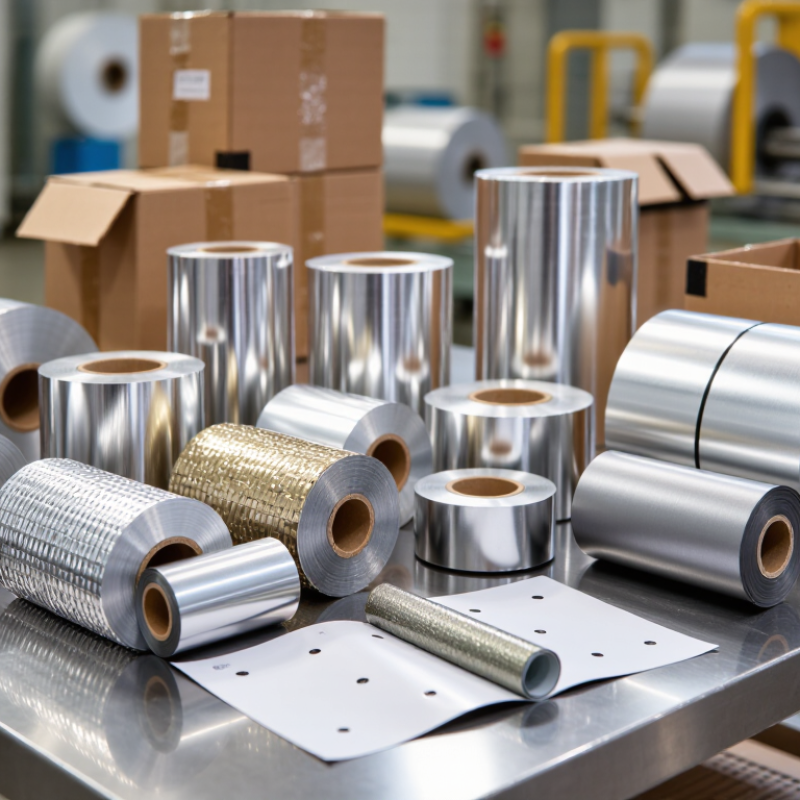
Classify the 10 Alu Foil Types by Alloy, Temper, and Thickness (6–200 µm)

Top 10 Types of Alu Foil Global Buyers Should Know

Classify the 10 Alu Foil Types by Alloy, Temper, and Thickness (6–200 µm)

Alu foil selection starts with alloy, temper, and thickness. These three details affect strength, forming, sealing, and surface performance. Type 1050 in O temper commonly ranges from 6–20 µm. It offers high purity and excellent flexibility. Type 1060, in O or H18 temper, usually covers 8–50 µm. Type 1070 O foil is softer and often specified at 6–20 µm. Type 1100 H14 provides moderate strength at 10–50 µm. Type 1235 O remains a thin option, often between 6–12 µm. Thin foil can tear easily.

Heavier applications require stronger grades. Type 3003 H14 typically ranges from 20–100 µm and handles moderate forming demands. Type 3004 H22 or H24 may reach 30–150 µm, offering better strength for rigid structures. Type 5052 H32 is commonly selected from 50–200 µm when higher strength and corrosion resistance matter. Type 8011 O or H22 often covers 8–80 µm and supports folding or general packaging uses. Type 8079 O, usually 6–50 µm, offers good flexibility for thin foil applications.

Buyers should confirm thickness tolerance, temper stability, pinhole limits, and coil width before approval. A 20 µm foil may perform differently after coating or laminating. Actual results also depend on rolling direction and forming speed. I have seen specifications look complete, yet omit temper verification. That small gap can cause wrinkles, cracking, or poor sealing during production.

Compare Packaging Foils by Barrier Performance: WVTR and OTR Below 0.01

Top 10 Types of Alu Foil Global Buyers Should Know

Packaging foil should be compared by barrier data, not appearance alone. Aluminium foil can block moisture, oxygen, light, and odors when its structure remains intact. For sensitive products, target WVTR and OTR values below 0.01. WVTR measures water vapor transmission, usually in g/m²/day. OTR measures oxygen transmission, often in cc/m²/day. Always confirm the test temperature, humidity, and pressure.

A thick foil may deliver excellent protection, but thickness alone does not guarantee performance. Pinholes, sharp folds, and weak seals can reduce the real barrier quickly. In packaging trials, a carefully formed laminate often performs better than a thicker foil with poor converting quality. Foil-paper laminates support dry products, while foil-polymer structures offer stronger heat-sealing control. High-barrier coated films can reduce material use, but their results depend heavily on coating continuity.

Test the complete package.

Ask suppliers for laboratory reports and production samples. Check WVTR and OTR before and after bending, sealing, and storage. A flat sample may show values below 0.01, yet the finished pouch can fail after repeated handling. That gap deserves attention. I have found that seal width, adhesive curing, and edge damage are sometimes more important than the foil grade itself. Test methods also vary, so direct comparisons can be misleading. A reliable buying decision combines barrier results, visual inspection, seal testing, and realistic transport conditions.

Top 10 Types of Alu Foil Global Buyers Should Know - Compare Packaging Foils by Barrier Performance: WVTR and OTR Below 0.01

No. Aluminium Foil Type Typical Packaging Structure Typical Foil Thickness Common Applications Typical WVTR
g/m²/day
Typical OTR
cm³/m²/day
Barrier Performance Notes
1 Pharmaceutical Blister Foil Aluminium foil / heat-seal lacquer 20–30 µm Tablet and capsule blister lidding <0.01 <0.01 Excellent protection against moisture, oxygen and light when the foil is pinhole-free and properly sealed.
2 Strip-Pack Foil Aluminium foil / heat-seal coating / aluminium foil 20–40 µm Unit-dose pharmaceutical packs <0.01 <0.01 Two foil webs provide redundant barrier protection and strong light shielding for sensitive products.
3 Cold-Form Blister Foil OPA / aluminium foil / PVC or PVC-based sealant 45–60 µm High-barrier pharmaceutical blister packs <0.01 <0.01 The aluminium layer supplies near-total barrier performance; forming quality and corner integrity are critical.
4 Lidding Foil for Cups and Trays Aluminium foil / heat-seal lacquer or polymer coating 30–50 µm Yogurt, dairy, sauces and ready meals <0.01 <0.01 High barrier depends on continuous coating, correct seal temperature and protection from pinholes.
5 Flexible Sachet Foil Laminate PET / aluminium foil / PE or CPP 7–12 µm Coffee, powders, sauces and personal-care sachets <0.01 <0.01 A thin foil layer provides strong barrier performance with low package weight; flex-crack resistance must be verified.
6 Retort Pouch Foil Polyester / aluminium foil / nylon / CPP 7–12 µm Sterilized meals, seafood and pet food <0.01 <0.01 Designed for severe thermal processing; laminate adhesion and seal integrity are essential after retorting.
7 High-Barrier Coffee Foil PET / aluminium foil / PE, often with a one-way valve 7–12 µm Roasted coffee, cocoa and aroma-sensitive powders <0.01 <0.01 Blocks oxygen, moisture and light; valve and zipper areas may become the practical barrier-limiting points.
8 Aluminium Foil for Dry-Food Laminates BOPP or PET / aluminium foil / PE 6–12 µm Nuts, spices, dehydrated foods and snacks <0.01 <0.01 Suitable for moisture- and oxygen-sensitive dry products when the laminate remains free from flex cracks.
9 Household and Foodservice Foil Uncoated aluminium foil 9–20 µm Wrapping, cooking, freezing and foodservice use <0.01 <0.01 The foil itself is an excellent barrier, but folds, tears, pinholes and loose wrapping reduce package-level performance.
10 Aluminium Foil for Insulation and Barrier Liners Aluminium foil / kraft paper, PE or air-bubble layer 12–30 µm Thermal insulation, building membranes and liner systems <0.01 <0.01 Provides a continuous radiant and gas barrier when joints, staples, penetrations and installation damage are properly controlled.
Measurement note: The values shown are typical performance targets for intact, pinhole-controlled aluminium-foil structures rather than guaranteed product specifications. WVTR is expressed in g/m²/day and is commonly evaluated at 38 °C and 90% relative humidity; OTR is expressed in cm³/m²/day and is commonly evaluated at 23 °C under dry conditions. Actual results depend on foil gauge, pinholes, flex cracking, seals, laminate design, test method and package geometry.

Match Household and Pharmaceutical Foils to Typical Gauges of 9–40 µm

Top 10 Types of Alu Foil Global Buyers Should Know

Gauge matters more than appearance when selecting aluminium foil. European Aluminium’s technical publication, Aluminium Foil in the Food and Pharmaceutical Industries, places common household foil around 9–24 µm. These thin gauges suit wrapping, cooking, and short-term storage. A 9 µm sheet feels flexible and tears easily. A 20–24 µm sheet offers better puncture resistance.

Pharmaceutical applications usually require thicker structures. Typical blister lidding foil ranges from about 20–30 µm, while strip-pack and stronger barrier formats may reach 30–40 µm. The same European Aluminium guidance links thickness with barrier performance, forming strength, and protection from light and moisture. A thicker gauge is not automatically better. It may increase material use and affect forming accuracy.

Quality teams should verify temper, pinholes, coating adhesion, and roll consistency. ASTM B479 provides relevant requirements for aluminium foil used in packaging, including surface and defect controls. However, gauge alone cannot confirm suitability. Actual performance depends on alloy, temper, sealant, and the complete laminate design. This is where buyers often oversimplify. A 20 µm foil may work well for one blister structure but fail during another forming process. Check certificates, test reports, and application trials before approving 9–40 µm material. Small differences matter.

Indicative aluminium foil gauge ranges commonly specified by household, food-service, packaging, and pharmaceutical buyers. Actual requirements vary by alloy, temper, forming method, coating, and laminate structure.

Evaluate Industrial Foils Across 1xxx, 3xxx, and 8xxx Alloy Series

Top 10 Types of Alu Foil Global Buyers Should Know

Industrial aluminium foil selection begins with alloy chemistry, not appearance. The 1xxx series offers high aluminium purity, excellent electrical conductivity, and strong corrosion resistance. It suits cable shielding, heat exchangers, flexible packaging, and household applications. However, it can tear more easily during deep forming. Buyers should check tensile strength, elongation, foil gauge, surface quality, and pinhole limits.

The 3xxx series contains manganese, giving it better strength while preserving useful formability. It is widely considered for heat exchanger fins, automotive components, and durable industrial covers. In practical sourcing, temper matters as much as alloy grade. A softer temper bends cleanly, while a harder temper improves rigidity. Rolling marks, edge cracks, and inconsistent thickness may still appear if process control is weak. Ask for test reports, not general claims.

The 8xxx series covers specialised alloys, often selected for packaging structures, battery components, and demanding barrier applications. These foils can provide a useful balance between strength, flexibility, and weight reduction. Yet “stronger” does not always mean better. Excessive hardness may reduce forming performance. I have seen buyers choose an alloy by price, then face higher scrap during slitting. That decision needs reconsideration. Evaluate the final forming speed, sealing method, coating compatibility, and storage conditions before comparing offers. A reliable supplier should explain tolerances clearly and provide traceable inspection data.

Verify Global Purchasing Specs Through ASTM, EN, and ISO Test Methods

Top 10 Types of Alu Foil Global Buyers Should Know

Aluminium foil looks simple, but purchasing specifications vary sharply by application. Common types include household foil, pharmaceutical foil, blister foil, food-container foil, cable foil, insulation foil, and heat-exchanger foil. Laminated, embossed, coated, and heavy-gauge grades also require separate checks. World Aluminium reported approximately 70 million tonnes of global primary aluminium production in 2023, showing the scale of this supply chain. Yet volume does not guarantee consistent foil performance.

Verify the alloy, temper, thickness, width, and surface condition against recognized test methods. ASTM B479 covers annealed aluminium-alloy foil requirements, including dimensions and quality controls. ASTM B557 supports tensile testing for wrought aluminium products. In Europe, EN 546-1 defines general foil conditions, while EN 546-2 addresses mechanical properties. ISO 6892-1 provides a tensile-testing method for metallic materials, and ISO 209-1 helps verify chemical composition. These references reduce disputes between mills, converters, and buyers.

Ask for batch-level inspection records, not only a general certificate. Check thickness at several points, because edge variation can affect sealing and forming. Pinholes need careful inspection under controlled light. Surface marks may look minor but can weaken laminated structures. ASTM, EN, and ISO results are not automatically interchangeable; test speed, sampling, and conditioning can differ. That detail is often missed. Buyers should compare the supplier’s method with the contract method before approval. Mistakes happen, especially when a familiar alloy is ordered for an unfamiliar process.