
Global demand for receipt, label, ticket, and mobile payment paper continues to expand. Smithers’ The Future of Thermal Paper to 2029 identifies retail, logistics, healthcare, and transportation as important growth sectors. Grand View Research also reports steady thermal paper market expansion, supported by e-commerce and digital payment infrastructure. These trends make Bpa Free Thermal Printer Paper a practical sourcing priority for international buyers.
However, “BPA-free” does not automatically mean risk-free or fully sustainable. Some suppliers replace BPA with BPS or other developers, creating additional evaluation questions. The European Chemicals Agency and REACH requirements underline the importance of checking chemical composition, documentation, and intended use. Buyers should request updated safety data sheets, test reports, coating specifications, and batch traceability before approving a manufacturer.
Paper performance matters, too. A receipt should print sharply, resist fading, and feed smoothly through different machines. Imagine a warehouse label exposed to heat, friction, and dust. Weak coating quality can quickly turn into unreadable inventory data. FSC certification may support responsible fiber sourcing, while ISO 9001 can indicate structured quality management. Neither certification replaces product testing.
The manufacturers featured in this guide are assessed through product consistency, production capacity, export experience, compliance transparency, and customization support. Supplier claims still require verification. That part is often overlooked. A reliable global partner should explain the thermal layer, core dimensions, roll tolerances, packaging protection, and storage conditions clearly. This guide helps buyers compare leading Bpa Free Thermal Printer Paper manufacturers with greater confidence, while recognizing that regional regulations and application requirements may differ.
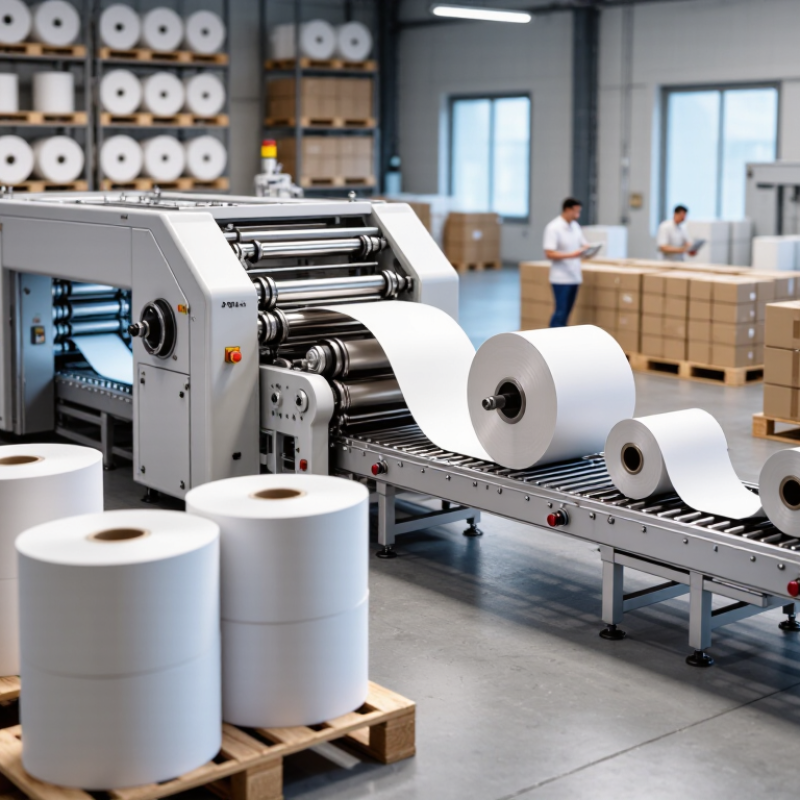
BPA-free thermal printer paper is made without bisphenol A as an intentionally added component of its heat-sensitive coating. The coating reacts to a printer’s heated printhead, producing text without ink or a ribbon. Simple in use. The chemistry still matters. “BPA-free” describes one specific substance, not every chemical in the paper, and it does not automatically mean the product is harmless or sustainable.
For buyers, a useful review goes beyond a label. Ask the manufacturer for a current material declaration and relevant test documentation, then check whether the stated scope covers the finished paper. It is also reasonable to ask what developer chemistry replaces BPA. Some alternatives have their own evidence and limitations. That distinction is easy to miss, especially when specifications are brief.
Performance deserves equal attention. Test sample rolls in the intended printer, checking print darkness, feed reliability, and legibility after ordinary handling and storage. A receipt that fades quickly creates avoidable reprints and customer confusion. Keep in mind that heat, light, and humidity can affect image life, regardless of BPA status. Supplier records, batch consistency, and clear storage guidance help buyers make a more informed choice. There is no perfect shortcut; a careful sample test may reveal issues that a specification sheet does not.
For global buyers, “BPA-free” should be a verified claim, not a carton label. Under the EU’s REACH restriction, thermal paper containing 0.02% BPA or more by weight cannot be placed on the market. Ask manufacturers for recent, batch-linked laboratory reports that state the test method, detection limit, and tested substance. A certificate without those details leaves gaps. EFSA’s 2023 BPA reassessment set a tolerable daily intake of 0.2 nanograms per kilogram of body weight per day. This is not a thermal-paper performance standard, but it shows why chemical disclosure deserves careful review.
Check what replaced BPA, too. Request screening for related developers, including BPS and BPF, rather than accepting a narrow BPA-only result. Then assess practical performance: print darkness, image retention, coating uniformity, and resistance to moisture and abrasion. Ask for samples and test them on the intended printers; a receipt that fades after a damp shift is a real procurement failure. Small details matter. Review paper weight, roll dimensions, core fit, and lot traceability against your operating conditions. Supplier audits and corrective-action records can reveal whether quality controls work consistently. No checklist is perfect, and one good sample cannot prove every production batch performs the same.
Leading BPA-Free Thermal Paper Manufacturers for Global Buyers should be assessed on more than a “BPA-free” label. Buyers need clear coating specifications, batch-level quality records, and consistent roll dimensions. Ask suppliers to identify the developer used in place of BPA and provide migration or chemical test results where relevant. Small details matter: a faint print, uneven coating, or curled roll can disrupt checkout operations.
The European Chemicals Agency’s restriction on bisphenol A in thermal paper sets a concentration limit of 0.02% by weight, effective in the EU from January 2020. This provides a useful benchmark for supplier documentation, though buyers should verify requirements in each destination market. For procurement context, Grand View Research estimated the global thermal paper market at about USD 4.2 billion in 2023, reflecting broad demand across retail, logistics, and healthcare. Market growth does not guarantee material quality. Not always.
Before placing a large order, request samples and test them in the actual printer models used by staff. Check image clarity after handling, storage performance, and compatibility with printers and cutters. Confirm production capacity, lead times, and traceability for each shipment. One practical weakness remains: “BPA-free” alone says little about other coating ingredients or long-term print performance. Independent test reports help close that gap.
Key BPA restrictions affecting thermal paper in France and the European Union
The chart shows the year-end status of thermal-paper BPA restrictions: France’s national ban took effect in 2015, followed by the EU-wide restriction in 2020. The EU restriction limits BPA to 0.02% by weight in thermal paper. These regulatory milestones can help global buyers assess supplier compliance; they are not market-share or manufacturer data.
Sources: Commission Regulation (EU) 2016/2235; French Law No. 2012-1442.
Quality control begins with the coating, not the label. Manufacturers can screen incoming base paper and coating chemicals, then test finished rolls for restricted substances, print clarity, and heat response. The European Chemicals Agency’s REACH restriction limits BPA in thermal paper to 0.02% by weight, effective since January 2020. That threshold is useful, but it does not prove every substitute is harmless. Labels are not enough. Buyers should request test methods, batch records, and recent laboratory results, including evidence that the paper prints legibly without excessive heat or coating transfer.
Environmental claims need similar scrutiny. The European Paper Recycling Council’s 2023 Monitoring Report estimated a 79.3% recycling rate for paper and board in Europe in 2022. That figure covers the wider paper stream; it does not mean thermal receipts are accepted in every recycling system. Responsible manufacturers can track fiber sourcing, coating waste, energy use, and rejected-roll volumes, then share measurable records with buyers. Small checks matter. A clean-looking roll tells little about its chemistry or disposal route, and supply-chain reporting can still leave gaps. Clear specifications make those gaps easier to spot.
Top BPA Free Thermal Printer Paper Manufacturers for Global Buyers
Before placing an order, confirm what “BPA-free” means in the supplier’s specification. Ask for a current declaration and relevant test reports, and check whether the claim covers the paper coating. BPA-free does not automatically mean free of every bisphenol. Clear wording matters. Compare paper weight, roll width, core diameter, and winding direction with your printer requirements. A few millimeters can cause feed problems.
Tips: Request samples from the production grade, not a specially prepared sample. Print receipts, then check image clarity, fading, dust, and paper curl after storage. Ask about minimum order quantities, production time, carton protection, and export documents. Keep the approved sample and specification for comparison.
A capable manufacturer should answer technical questions consistently and explain how quality is checked between batches. Ask how they handle defects and whether they can share inspection records. One sample is useful, but it cannot prove every future batch will match. I would also confirm shipping terms and destination details in writing; these are easy to overlook when price discussions move quickly. Don’t choose on price alone.
| Check Area | What to Specify | Evidence to Request | Practical Order Check |
|---|---|---|---|
| BPA-free claim | Define whether the requirement is “BPA-free” only or also excludes other specified phenolic developers. | A current, product-specific declaration and, where required, an independent laboratory report stating the test method and reporting limit. | Confirm the report covers the exact paper grade and coating supplied. “BPA-free” alone does not establish that a product is free of every bisphenol or phenolic substance. |
| Roll dimensions | Specify roll width and maximum roll diameter in millimetres, core inside diameter in millimetres, and any tolerance your printer requires. | Dimensioned product specification and a sample measured against the agreed tolerances. | Check the printer manual or existing approved roll; do not assume rolls with the same width will fit if their diameter or core differs. |
| Paper weight and thickness | State the required grammage in g/m² and thickness in micrometres (µm), including acceptable tolerances. | Technical data sheet identifying the measurement method and specification range. | Compare samples with the intended printer and application; grammage and thickness are related but are not interchangeable specifications. |
| Thermal image performance | Define print darkness, image uniformity, barcode readability, and performance on the intended printer type. | Representative production samples and recorded results from a test using the buyer’s printer or an agreed test procedure. | Check for clear text, scannable barcodes, even printing, and no unacceptable smudging or background marks. |
| Coated side and winding | State which side is heat-sensitive, winding direction, and whether printing is required on one side only. | Written roll specification, winding diagram, and physical sample. | Verify that the coated side faces the print head in the buyer’s printer and that the roll feeds in the required direction. |
| Image life and storage | Set the required legibility period and storage conditions for the intended receipt, label, or record use. | Test data describing the method, exposure conditions, and evaluation period; storage guidance for unused rolls. | Do not treat a general “long-life” statement as a guarantee; heat, light, humidity, friction, and contact with chemicals can affect thermal images. |
| Regulatory requirements | Identify destination countries and the regulations or restricted-substance requirements applicable to the product and its use. | Applicable declarations, test reports, and safety or compliance documents for the specified market. | Requirements vary by market and application; verify current obligations with the importer or qualified compliance adviser. |
| Packaging and transport | Specify individual roll wrapping, carton quantity, carton markings, pallet requirements, and protection from moisture and heat. | Packaging specification, carton dimensions and gross weight, plus photographs or a pre-shipment sample if needed. | Check packaging suitability for the shipping route and warehouse conditions, and ensure labels match the purchase order. |
| Quality control and traceability | Agree inspection criteria, defect handling, batch identification, and the documents supplied with each shipment. | Quality plan or inspection record, batch or lot coding, and a documented process for reporting non-conforming goods. | Make acceptance criteria measurable before production, including dimensional checks and agreed print-performance tests. |
| Commercial terms | Confirm minimum order quantity, sample availability, production lead time, payment terms, delivery terms, and order validity. | A dated quotation and written order confirmation covering specifications, quantities, and agreed terms. | Compare quotations on the same roll specification, packaging basis, delivery scope, and currency before placing an order. |
Buyer note: Treat numerical tolerances, compliance claims, and performance commitments as purchase-order requirements only after they have been confirmed in writing for the specific paper grade and destination market.
