
Top China Coffee Bags Supplier for Global Buyers?
Choosing the top China Coffee Bags supplier for global buyers requires more than comparing catalog prices. A reliable supplier should understand packaging performance, export documentation, and the practical demands of different coffee markets. The right Coffee Bags must protect aroma, resist moisture, and seal cleanly after filling. Details matter.
A well-made bag should feel balanced in the hand, not overly thin or rigid. Its zipper should close smoothly, while the heat seal remains firm under normal handling. Buyers should request material specifications, barrier test results, printing proofs, and production samples before placing large orders. Factory audits, quality records, and clear communication also reveal more than attractive product photos. Ask about minimum order quantities, lead times, carton protection, and support for private-label designs. These checks reflect real purchasing experience, not just online research.
No supplier is perfect. A polished sample may not represent every production batch. That assumption needs checking. Independent inspections can help confirm dimensions, color consistency, valve placement, and seal strength before shipment. Experienced suppliers should also explain whether kraft paper, matte film, aluminum layers, or recyclable structures suit a buyer’s goals. They should discuss limitations honestly.
The “top” supplier depends on the buyer’s product, budget, market, and quality expectations. A small roaster may value flexible quantities and fast artwork revisions. A large importer may prioritize stable capacity and documented process control. Careful comparison creates fewer surprises. It also builds a stronger foundation for long-term packaging cooperation.
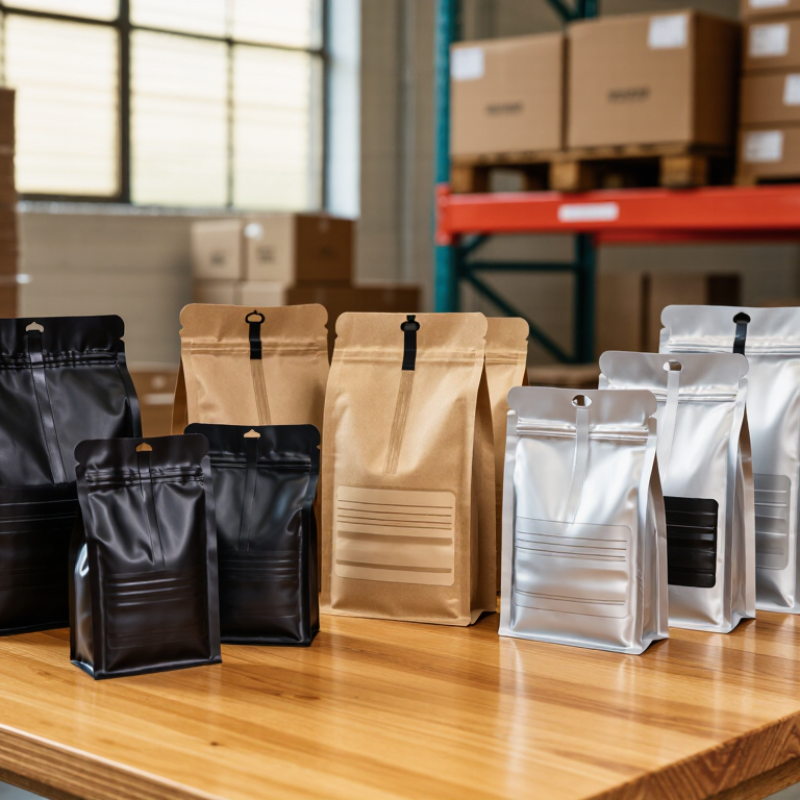
Understanding China’s Coffee Bag Manufacturing Industry
China’s coffee bag manufacturing industry serves roasters, distributors, and retailers across many markets. Factories commonly produce kraft paper, PET, PE, and aluminum laminate structures. Each material affects barrier performance, appearance, and recycling options. For global buyers, the right supplier should understand coffee freshness, not only printing quality. Experience matters.
A capable factory checks oxygen transmission, moisture resistance, seal strength, and valve performance. Degassing valves are especially important for freshly roasted coffee. A weak seal can allow aroma loss within weeks. Buyers should request production samples, material specifications, food-contact declarations, and test reports before placing large orders. Factory audits can also reveal storage conditions, cleanliness, and process control. These details often matter more than a polished catalog.
Customization usually includes pouch size, zipper style, valve position, surface finish, and printing method. Rotogravure printing suits larger volumes, while digital printing may reduce setup pressure for smaller trials. Minimum order quantities vary widely, so written quotations should clarify tooling, waste rates, lead times, and inspection standards. I have found that communication is often the fragile part. A supplier may confirm a drawing, yet miss a small measurement during production. Clear artwork files and signed pre-production samples reduce that risk, although they do not remove it. A reliable partnership needs regular checks, honest feedback, and room to improve.
Top China Coffee Bags Supplier for Global Buyers? - Understanding China’s Coffee Bag Manufacturing Industry
Buyer-oriented manufacturing benchmarks for coffee packaging sourced from China
| Packaging Dimension | Common Options in China | Typical Technical Range | Best-Suited Coffee Application | Key Buyer Considerations |
|---|---|---|---|---|
| Bag Format | Flat-bottom, side-gusset, quad-seal, stand-up pouch, and pillow bag | Typical finished widths: 80–180 mm Typical heights: 130–300 mm | Whole beans, ground coffee, capsules, samples, and refill packs | Flat-bottom and quad-seal formats provide stronger shelf presence; pouches generally reduce material and shipping volume. |
| Common Fill Capacities | Sample, retail, foodservice, and bulk formats | Approximately 30 g, 100 g, 250 g, 340 g, 500 g, 1 kg, and 2 kg | Retail coffee, subscription boxes, cafés, roasters, and hospitality supply | Actual capacity depends on coffee density, roast level, grind size, bag geometry, and headspace requirements. |
| Typical Laminate Structures | OPP/CPP, PET/PE, PET/CPP, PET/VMPET/PE, PET/AL/PE, and paper-based laminates | Usually 2–4 layers, selected according to barrier, sealing, appearance, and recyclability targets | Standard roasted coffee and products requiring extended aroma protection | Aluminum foil delivers very high barrier performance; metallized films can offer a lighter alternative with different recycling characteristics. |
| Film Thickness | Flexible laminate constructions for light, medium, and heavy-duty bags | Common total thickness: approximately 90–180 microns | Retail packs from small sample bags to 1 kg formats | Thicker structures improve stiffness and puncture resistance but may increase material use and freight weight. |
| Oxygen and Moisture Barrier | Standard barrier, high barrier, and ultra-high barrier constructions | Performance varies by laminate; buyers commonly specify maximum OTR and WVTR values rather than relying only on material names | Freshly roasted coffee, specialty coffee, and long-distance export shipments | Request laboratory test results for oxygen transmission rate, water vapor transmission rate, seal integrity, and shelf-life validation. |
| Degassing Valve | One-way valve, internal valve, external valve, or valve-free design | Commonly used for freshly roasted whole-bean and ground coffee | Products that release carbon dioxide after roasting | A valve allows gas to escape while limiting oxygen ingress; valve placement and seal quality should be checked during filling trials. |
| Closure Systems | Press-to-close zipper, tin tie, hook-and-loop closure, or heat-sealed top | Zipper widths commonly range from about 8–15 mm depending on bag construction | Retail packs requiring repeated opening and resealing | Heat sealing remains important even when a zipper is used, especially for export distribution and aroma retention. |
| Surface Finish | Gloss, matte, soft-touch, kraft-paper appearance, spot varnish, and clear window | Rotogravure, flexographic, digital, and specialty finishing options | Premium retail packaging, private-label coffee, and seasonal products | Matte and specialty finishes can increase visual appeal; clear windows may reduce barrier performance unless carefully designed. |
| Printing Capability | Rotogravure, flexographic, and digital printing | Typically 1–10 colors depending on process and artwork requirements | Custom printed packaging for regional and international markets | Rotogravure is commonly suited to larger repeat orders, while digital printing is useful for short runs, test launches, and multiple designs. |
| Food-Contact Compliance | Documentation for film, ink, adhesive, valve, zipper, and other components | Requirements depend on the destination market, such as the European Union, United States, United Kingdom, Canada, or Australia | All coffee bags intended for commercial food packaging | Request declarations of compliance, migration test reports, material specifications, and traceability documentation before production. |
| Quality-Control Checks | Incoming material inspection, color control, seal testing, dimensional checks, and finished-pack inspection | Common checks include bag dimensions, film thickness, seal strength, leak resistance, print registration, and valve function | Export orders and products requiring consistent appearance across batches | Agree on approved samples, defect classifications, inspection methods, and acceptance limits before mass production. |
| Indicative Production Timeline | Sampling, cylinder or plate preparation, printing, lamination, curing, bag making, and inspection | Samples often require about 7–15 working days; repeat production commonly requires about 20–35 working days after artwork and specifications are approved | Planned retail launches and recurring replenishment programs | Timelines vary with structure, printing method, order quantity, artwork changes, material availability, and peak-season capacity. |
| Sustainability Options | Mono-material PE or PP structures, reduced-material designs, recyclable paper laminates, and post-consumer recycled content where permitted | Recyclability depends on local collection systems, structure composition, barrier requirements, inks, adhesives, and applicable regulations | Brands targeting lower material complexity or market-specific sustainability claims | Do not treat a “recyclable” claim as universal; verify the exact structure and destination-market requirements with supporting documentation. |
| Export Logistics | Flat-packed bags supplied in cartons or on pallets | Packaging is generally lightweight and space-efficient before filling; carton quantity depends on bag size and thickness | International buyers, coffee roasters, distributors, and contract packers | Confirm carton dimensions, gross weight, pallet configuration, shipping marks, moisture protection, and Incoterms before placing an order. |
Important: The figures above are practical industry reference ranges rather than guarantees. Final specifications should be confirmed through approved samples, technical data sheets, testing reports, and destination-market food-packaging regulations.