Who Are the Top Foil Container Manufacturers in China?
China’s foil container industry serves restaurants, food processors, retailers, and exporters. Its manufacturers vary widely in equipment, production scale, and specialization. A polished product photo tells only part of the story. Buyers also need to assess alloy consistency, rim strength, forming accuracy, and lid fit.
Packaging author Walter Soroka describes packaging as “the science, art, and technology of enclosing or protecting products for distribution, storage, sale, and use.” That perspective suits foil containers well. A tray must do more than look neat; it needs to hold its shape through filling, transport, and everyday handling. Small details matter. A curled edge or loose lid can complicate packing lines and disappoint customers.
This guide examines leading Chinese manufacturers through practical criteria, including product range, production capability, customization, quality controls, and export support. It also considers how clearly suppliers communicate specifications and provide relevant documentation. No ranking can fit every buyer. A large factory may suit high-volume orders, while a smaller specialist may offer more responsive customization. There is room for judgment here. Company claims should be checked against samples, records, and direct questions before a sourcing decision is made.
China’s Aluminum Foil Container Manufacturing Landscape
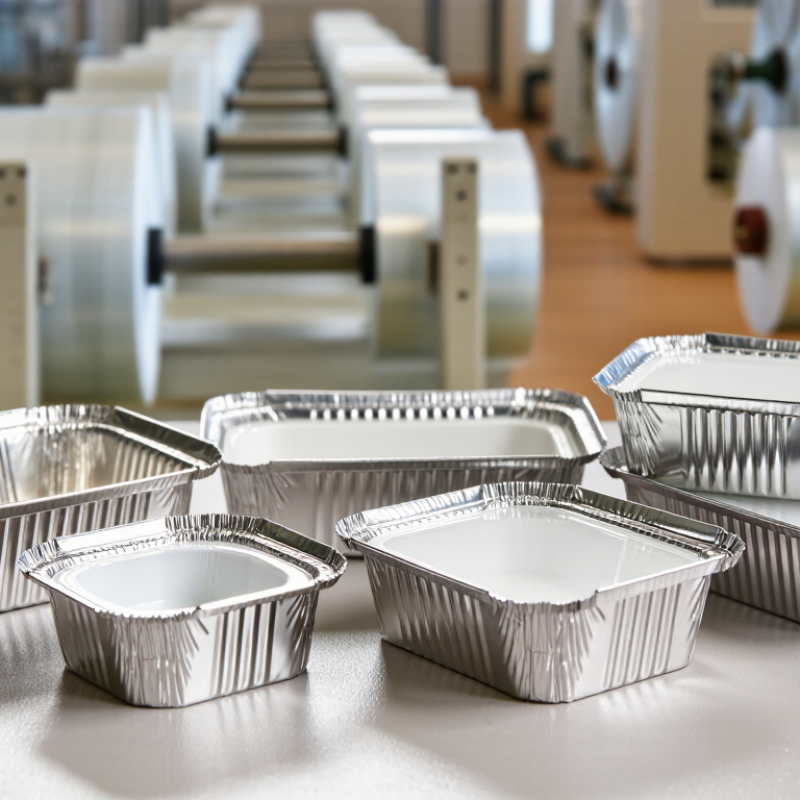
China’s aluminum foil container manufacturing landscape includes large, export-focused plants and smaller regional producers. Their capabilities can differ in tooling, production volume, and quality control. A factory’s catalog alone does not show how consistently it can form a container or maintain its dimensions.
Production starts with foil stock selected for the intended use. Operators feed coils through presses, where dies shape trays, bowls, or lidded containers. The rim needs close attention. A clean, even edge helps a lid fit and makes the container easier to handle. Small differences in alloy temper or foil thickness can affect rigidity, so buyers often compare samples rather than relying only on product photos. Details matter.
Manufacturers may also offer printing, custom shapes, and packing options, but each can affect lead time and minimum order quantities. Practical checks include reviewing material specifications, inspecting sample edges, and asking how defects are recorded. Claims deserve verification. Not every supplier has the same testing resources, and a polished presentation is not proof of stable output. The landscape is broad, and sometimes difficult to read from a distance.
China’s Aluminum Foil Container Manufacturing Landscape
China’s primary aluminum production provides context for the upstream material supply supporting foil-based manufacturing. It is not a measure of foil container output.
Annual primary aluminum (electrolytic aluminum) production, in million metric tonnes. Source: National Bureau of Statistics of China, annual production data.
How to Identify Leading Foil Container Manufacturers
China’s scale makes careful screening essential. The International Aluminium Institute’s 2023 production statistics put China’s primary aluminium output at about 41.6 million tonnes. That figure reflects metal production, not a factory’s ability to roll, form, and inspect container foil consistently. Ask for documented thickness tolerances, alloy specifications, and inspection results. Request samples from regular production, not specially prepared pieces. Check the rim curl, nesting fit, and foil surface under bright light. Small defects matter.
The IAI’s Global Aluminium Cycle Model estimates that roughly 75% of all aluminium ever produced remains in use. Treat this as context, not proof of a supplier’s recycled content or product quality. Ask for batch-level material records and traceability documents. Numbers need context. Review the manufacturer’s quality procedures, food-contact documentation, production capacity, and delivery records; verify claims against actual records. A factory visit can reveal line flow and storage conditions, but a single visit may not show every shift. Ask for records from an ordinary production day. A polished audit can still miss a weak handover between shifts, so leave room to question your own first impression.
Profiles of Notable Chinese Foil Container Manufacturers
Chinese foil container manufacturers vary in scale, specialization, and quality-control practices. Some operate integrated facilities, managing foil forming, trimming, inspection, and packing under one roof. This setup can improve consistency between production stages.
Buyers can ask for sample containers and compare rim shape, wall thickness, and lid fit.
Small details matter.
Other manufacturers focus on custom food-service formats, such as shallow trays for baked goods or deeper pans for prepared meals. Their strengths may include flexible tooling and the ability to handle varied order sizes. Export-oriented producers may offer more structured documentation and packing options.
These are useful indicators, not guarantees. A polished catalogue cannot replace factory audits or repeat sample checks.
Ask how defects are recorded, how batches are traced, and whether specifications remain stable across production runs. Some suppliers explain this clearly; others do not. That gap deserves attention.
A manufacturer’s profile is strongest when its stated capabilities match observable production evidence, realistic lead times, and consistent communication.
Products, Production Capabilities, and Quality Standards
Who Are the Top Foil Container Manufacturers in China?
Products, Production Capabilities, and Quality Standards
When comparing Chinese manufacturers, look beyond catalog photos. Common products include takeaway trays, household foil, and lids. Ask about alloy, temper, thickness range, container dimensions, and tooling options. The USGS Mineral Commodity Summaries 2024 estimated China produced 41 million metric tons of primary aluminum in 2023. That figure shows upstream scale, not a factory’s foil-container capacity or consistency. Small details matter.
Production capability is easier to verify through sample runs and records. Check whether the factory controls rolling, annealing, stamping, and edge trimming in-house. Request thickness-tolerance data, pinhole inspection methods, and batch traceability. For food-contact applications, ask for current test reports relevant to the intended market, plus documented quality systems such as ISO 9001 or ISO 22000. Certificates alone are not proof that every shipment meets specification. A supplier may have strong equipment but uneven process control; that is worth checking.
Tips: Send a drawing and target thickness, then compare measured samples from multiple production batches. Ask how defects are recorded and corrected. No checklist is perfect. Test the actual container before placing a large order.
How to Choose a Manufacturer for Your Business Needs
Choosing a foil container manufacturer in China starts with your actual use case.
A bakery may need shallow trays that release cleanly, while a meal producer may need deeper containers with secure-fitting lids. Share target dimensions, wall thickness, alloy requirements, order volume, and packing method before comparing quotes. Ask how thickness is measured and how often production samples are checked. Small differences can affect stiffness and lid fit.
Request samples from a regular production run, not only a specially prepared set.
Check the rims for sharp edges, stack several containers, and test them with your filling and heating process. Ask for relevant material and quality records, then confirm they match the requirements of your destination market. Also review mold ownership, lead times, defect handling, and export-carton strength. A low unit price can look attractive; freight, tooling, and inconsistent batches may change the real cost. I would not rely on a polished sample alone.
Tips:
Compare the same specifications across suppliers. Put approved dimensions and tolerances in writing. Ask for a pre-shipment inspection when the first order is large. Keep one sample from each approved batch for reference. Communication matters, too. If a supplier answers clearly but misses a small detail, clarify it before production rather than assuming it will sort itself out.